Quick answer: An incremental game is one where you pile up a resource, spend it on things that make more of that resource, and repeat until the numbers get silly. Clicker games lean on you doing the clicking. Idle games carry on earning while you are away. Most modern incremental games mix the two.
You click a cookie and get a cookie. A few more clicks and you can buy a cursor that clicks for you. An hour later you own a cookie factory, the counter has more digits than your bank balance, and you could not tell anyone why you are still there.
That is the whole genre, more or less, and it has kept people busy for over twenty years.
What is an incremental game?
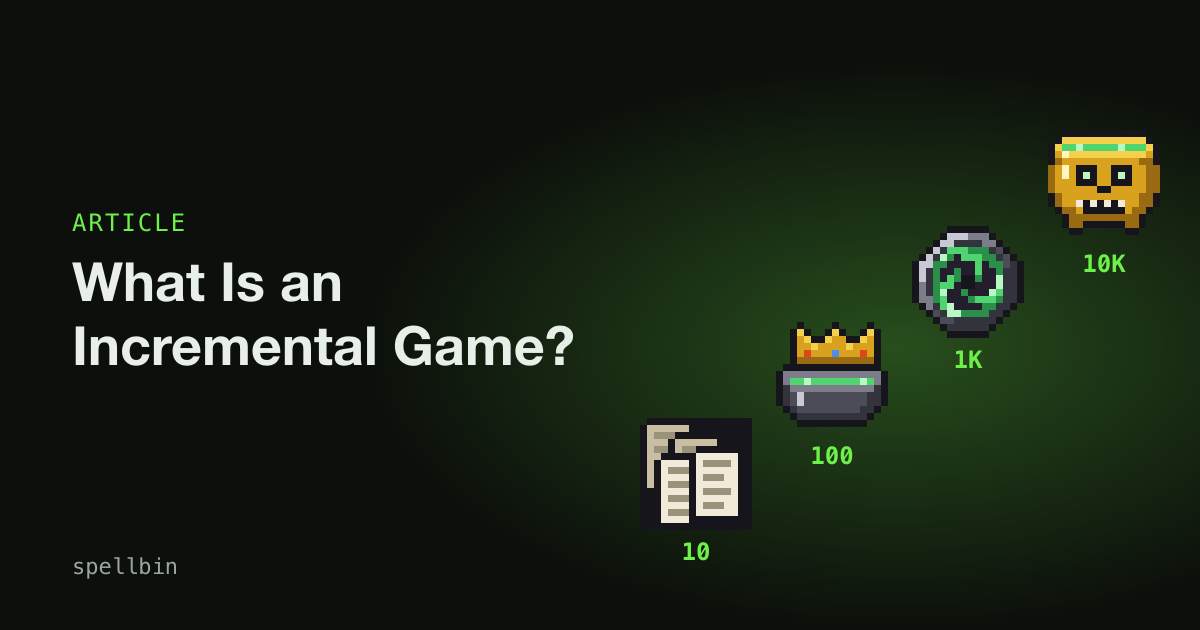
An incremental game is built around a number that keeps going up. Wikipedia's incremental game entry defines the genre by "the incremental accumulation of in-game resources", with progress that is often exponential. You earn something, spend it on ways to earn more, and watch the rate climb.
There is usually no way to lose. Your progress just gets bigger, faster or both, and the game keeps finding new things for you to spend it on.
What is the difference between idle, clicker and incremental games?
Incremental is the umbrella; idle and clicker describe what you do while playing. Wikipedia's entry sorts them this way:
- Clicker games put the weight on active input, such as clicking a button over and over to make resources.
- Idle games put the weight on automation, so progress continues with little or no input from you.
- Most games are both. You click at the start, buy things that click for you, then mostly check in.
In practice people use the three words interchangeably, and usually mean the same cookie.
How does the core loop work?
Nearly every incremental game is built from generators, upgrades and costs that rise faster than your income.
Generators
A generator is anything that makes the resource for you. Cursors, grandmas, lemonade stands. Each one earns a trickle every second, and ten of them make a stream.
Upgrades
Upgrades multiply what the generators already make. One might double every grandma's output, another might make clicks worth more. Most of the "number go up" feeling comes from here.
Exponential costs
Each generator costs more than the last. Anthony Pecorella's The Math of Idle Games, first written for Kongregate's developer blog, explains that this is "typically accomplished by having costs grow exponentially while production grows at a linear or polynomial rate." His example from AdVenture Capitalist uses a cost growth rate of 1.07 per lemonade stand owned.
That mismatch drives the whole game. Early on, production outruns prices and everything feels cheap. Later, prices pull ahead, the waits get longer, and the game nudges you towards the next system.
What is prestige in an idle game?
Prestige is a voluntary reset that makes your next run faster. You give up most of your progress in exchange for a permanent bonus that carries over. Wikipedia's Cookie Clicker article describes the game's version: ascending resets your bakery, and each prestige level adds a permanent 1% boost to cookie production in future runs.
It sounds like a bad deal, but once costs have pulled too far ahead, starting over with a multiplier gets you past your old high point quicker than grinding would. Some games stack several prestige layers on top of one another, each resetting the one below.
Where did incremental games come from?
A surprising amount of the genre started as a joke.
- Progress Quest (2002). Eric Fredricksen made Progress Quest as a parody of EverQuest and other online role-playing games. Once you make a character, there is no interaction at all. The game plays itself.
- Cow Clicker (2010). Ian Bogost released Cow Clicker on Facebook on 21 July 2010 to mock the mechanics of social games. You could click your cow once every six hours. People took it seriously anyway.
- Candy Box (2013). A student using the name aniwey released Candy Box in April 2013. It starts with a candy counter and a save button and grows into an ASCII-art role-playing game.
- A Dark Room (2013). Michael Townsend of Doublespeak Games released A Dark Room as a browser game on 10 June 2013. You light a fire, and a text adventure gradually builds up around it.
- Cookie Clicker (2013). Julien "Orteil" Thiennot made Cookie Clicker on 8 August 2013, and the Wikipedia entry for the genre says incremental games "gained popularity in 2013 after the success of Cookie Clicker."
- Universal Paperclips (2017). Frank Lantz released Universal Paperclips on 9 October 2017. You play an AI built to make paperclips, and the game ends if it turns all the matter in the universe into them.
So the genre started out mocking games and ended up being one.
Why do incremental games use big-number notation?
Because the numbers outgrow normal words. Cookie Clicker's Wikipedia article notes that players can reach "trevigintillions" of cookies, which is 10 to the power of 72.
Wikipedia's genre entry lists scientific notation, short suffixes like "1M for million, 1T for trillion" and special naming schemes for very large numbers. It also notes that some games need specialised data types or number libraries just to store the values. The notation is there so the counter stays readable, and you still get to feel smug about it.
How do you play incremental games on a Mac?
The easiest way in is a browser. Many of the classics started on the web and still run there.
- Universal Paperclips has a web version that opens in Safari.
- A Dark Room is still hosted in the browser by Doublespeak Games.
- Cookie Clicker has a browser version and a Steam release that lists macOS 11 or later on an Apple M1 or Intel processor.
For a longer list of what runs well on macOS, see our roundup of the best incremental games for Mac.
Your first hour with an idle game
- Pick one browser game. Universal Paperclips is a good first choice because it has an ending.
- Click until you can buy a generator. Then buy it. Your first automation is the moment the genre clicks.
- Put money into upgrades before more generators. A doubling upgrade often beats one extra building.
- Leave it running. Keep the tab open, come back later and see what piled up.
- Prestige when progress stalls. If the next purchase is hours away, a reset with a bonus is usually the faster route.
An incremental game where the click is a drop
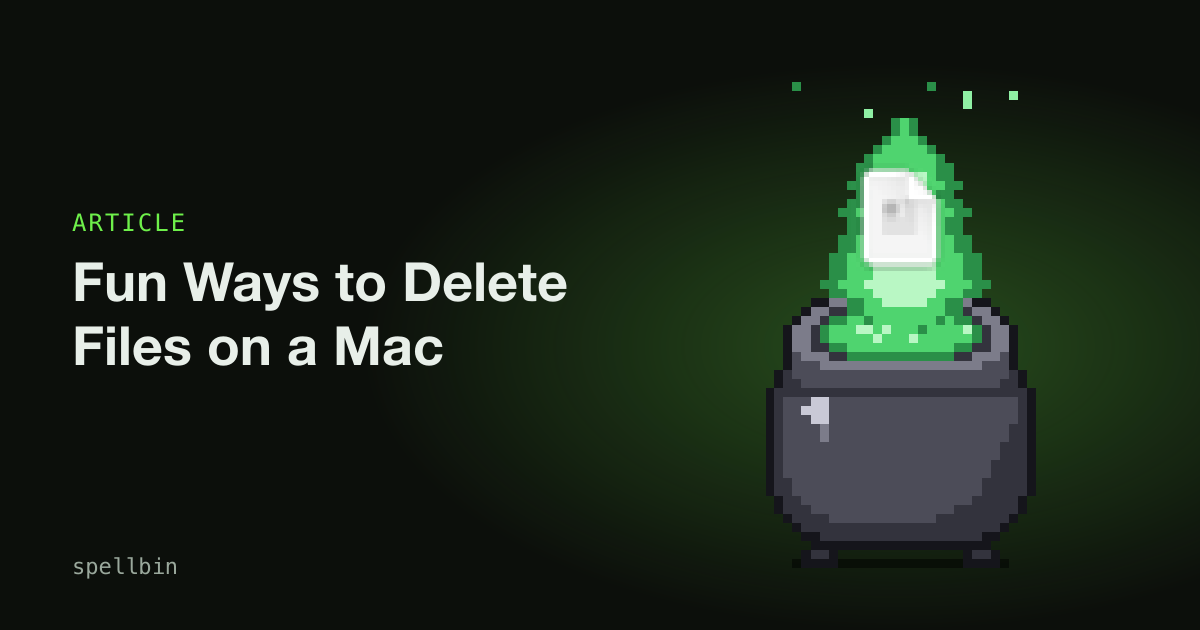
Incremental games turn small actions into big counters. Spellbin, our own small paid Mac app, does the same for deleting files. It is a pixel-art cauldron that sits in the Dock beside the Bin. Drop a file on it and a green flame carrying the file's thumbnail rises out of the acid and dissolves. By default the file goes to the real Bin underneath. A stats window tracks items binned, bytes freed and streaks, and 19 achievements unlock new cauldron skins, 15 in all counting the default Iron. Think Cookie Clicker where the click is a drop.
There are no generators and no prestige layers, and it won't clean your Mac or speed it up. It just gives the files you were going to delete anyway a number to go up.
An incremental game is a promise that tomorrow's number will be bigger than today's. It usually keeps it.
Frequently Asked Questions
What was the first incremental game?
Progress Quest, released by Eric Fredricksen in 2002, is usually called the first idle or incremental game. It parodied online role-playing games by playing itself: after you create a character, there is no further interaction. Cow Clicker in 2010 and Cookie Clicker in 2013 brought the genre to much bigger audiences.
Are idle games and clicker games the same thing?
Idle games and clicker games are two sides of the incremental genre. Clicker games lean on active input such as clicking a button, while idle games lean on automation that earns while you are away. Most modern incremental games start as clickers and turn into idle games once you can buy generators.
Why do incremental game costs keep going up?
Incremental game costs rise exponentially with each generator you own, while production grows more slowly. Anthony Pecorella's analysis of idle game maths describes this as the genre's core balance. It makes early purchases feel quick and later ones slow, which pushes you towards upgrades, new systems and eventually a prestige reset.
Is Cookie Clicker available on Mac?
Cookie Clicker is available on Mac through Steam, where the store page lists macOS 11 or later with an Apple M1 or Intel processor. The game also has a browser version that runs in Safari or any modern browser. The Steam version was published by Playsaurus on 1 September 2021.
Why are incremental games so addictive?
Incremental games keep you returning with small, steady rewards and progress that builds up while you are away, and there is always a next purchase within reach. We cover the psychology in why incremental games are so addictive.
Final Takeaways
- Incremental is the genre, with clicker and idle as the two ways of playing it.
- The loop is generators, upgrades and rising costs, and the gap between costs and production drives the whole game.
- Prestige trades progress for a permanent multiplier. Reset when you stall.
- Start in a browser on your Mac. Universal Paperclips and A Dark Room need nothing installed.

Josh Ibbotson
Josh is an indie developer in the UK. He makes Spellbin, a pixel-art cauldron for your Dock, and Gym Note Plus.
Feed the cauldron
Spellbin is $4.99 once, for macOS 14 or later, with a 14-day money-back guarantee. Drop files on it, unlock skins, keep your Desktop tidy.
Get Spellbin for $4.99Already bought Spellbin? Download it here