Quick answer: Incremental games are addictive because they stack several well-studied pulls into one loop. Rewards arrive on a mix of fixed and unpredictable schedules, the next upgrade always looks close, unfinished goals nag you back, numbers only go up, and prestige resets feel like progress rather than loss. Very little attention is needed for any of it.
You open Cookie Clicker to see how it works. Forty minutes later you are doing sums about whether a ninth grandma pays for herself before a factory does, and the cookie count has a word in it you have never needed before.
The genre runs on ideas psychologists and game designers have studied for decades. Some of the science holds up better than the pop version, and the loop has an off switch, even if the game never shows you where it is.
What makes incremental games different from other games?
They are designed to be played less. Our guide to what an incremental game is has the full definition; the short version is a small economy that keeps producing while you do other things.
A 2018 CHI paper, Playing to Wait: A Taxonomy of Idle Games, looked at 66 of these games and described them as balancing "rules that encourage players to leave the game and rules that reward them for returning." The authors argue the genre moves players "from playing to planning". The fun is less in what you click and more in how your choices compound over time.
A game you can never really finish, and never really lose, is easy to go back to.
Why do incremental game rewards feel so good?
Fixed rewards you can count on
Most rewards in an incremental game arrive on a fixed schedule. Buy the tenth building and its output doubles. Reach a round number and an upgrade unlocks. This is close to what C. B. Ferster and B. F. Skinner called fixed-ratio reinforcement in their 1957 book Schedules of Reinforcement: a reward after a set amount of effort.
Fixed rewards let you see the next milestone and plan around it. That planning is half the game.
Surprises you cannot predict
Then the game drops in something random. The CHI paper points to golden cookies in Cookie Clicker and astronomical events in Kittens Game: short windows where a click earns a special bonus. Unpredictable payouts are the variable schedule Ferster and Skinner described, and it is the comparison everyone reaches for when they call these games slot machines.
The CHI authors note a difference: in idle games these events "provide bonuses but do not introduce penalties". Missing a golden cookie costs you a bonus. It does not cost you anything you already had.
Why does the next upgrade always feel so close?
The goal-gradient effect says effort speeds up as a reward gets nearer. Ran Kivetz, Oleg Urminsky and Yuhuang Zheng tested it in a 2006 paper in the Journal of Marketing Research. Café customers on a buy-ten-get-one-free card bought coffee more often as they approached the free one, then eased off after collecting it and sped up again as the next one came into view.
Incremental games are a long chain of loyalty cards. Costs rise steeply, but so does income, so there is always an upgrade almost paid for.
Why do unfinished goals keep pulling you back?
This is usually explained with the Zeigarnik effect, and that explanation is shakier than it sounds. The idea, from Bluma Zeigarnik's 1920s work, is that we remember unfinished tasks better than finished ones. A 2025 meta-analysis by Romain Ghibellini and Beat Meier found no memory advantage for unfinished tasks.
What they did find was a general tendency to resume interrupted tasks, known as the Ovsiankina effect. That is the part incremental games use: you feel like going back to finish the half-built thing, and there is always a half-built thing.
Why does it feel like progress even when you are barely playing?
Numbers that only go up feel like getting better at something. Anthony Pecorella, then at the browser game site Kongregate, told a GDC audience in 2015 that "Everything is 'going up' so it feels like you're always progressing," as reported in Game Developer's write-up of the talk.
Time away helps rather than hurts. A check-in after a few hours buys a pile of upgrades at once, which Pecorella called "a celebratory moment every time that you return."
Self-determination theory gives the deeper reason. In The Motivational Pull of Video Games, Richard Ryan, Scott Rigby and Andrew Przybylski found that feelings of competence and autonomy predicted enjoyment of games and the wish to keep playing. A number that grows because of choices you made is competence with a counter attached.
Achievements and collections
Achievements give the long game short-term goals. Juho Hamari and Veikko Eranti's framework for game achievements describes them as optional challenges supplied by a meta-game that lasts beyond a single session. An achievement you are halfway to is one more open loop, and a grid of locked badges is a collection asking to be finished.
Play that fits around everything else
Incremental games ask for very little attention. The CHI paper says they "do not merely wait at the periphery of a player's attention, but actively place themselves there," and that leaving them in the background makes them "easy to interleave with daily activities."
So they live in a browser tab beside work or on a second monitor. Sonia Fizek's paper on interpassivity and delegated play goes further: these games largely play themselves. Starting never feels like work.
Why does resetting with prestige feel like winning?
Prestige turns a fresh start into a power-up. In The Math of Idle Games, Part III, Pecorella calls prestige "one of the crucial mechanics behind most modern idle games": you reset your progress in exchange for a multiplier that makes the next run faster.
He writes that prestige layers "create the 'ladder climbing' effect that contributes to why idle games are so compelling." Starting again feels less like losing everything and more like proof you have got stronger. It is a neat trick.
When does the loop stop being fun?
When checking in feels like a chore rather than a treat. No failure state and endless next goals make incremental games relaxing, and they also mean there is no natural place to stop.
The World Health Organization's Q&A on gaming disorder says the condition "affects only a small proportion of people" who game, and suggests watching your time spent, "particularly when it is to the exclusion of other daily activities." So most players have nothing to worry about, but it is still worth noticing if a tab has started running you.
How to step away
- Notice the trigger. If you open the game out of habit rather than interest, that is the moment to close it.
- Set a finish line yourself. Pick an achievement or prestige level and stop when you reach it, since the game will not offer one.
- Turn off notifications. Return bonuses work best when the game can remind you they exist.
- Let the save go. Stopping costs you nothing you will miss next week.
The same loop, pointed at your Downloads folder
Our roundup of the best incremental games for Mac covers the full games. This is something smaller.
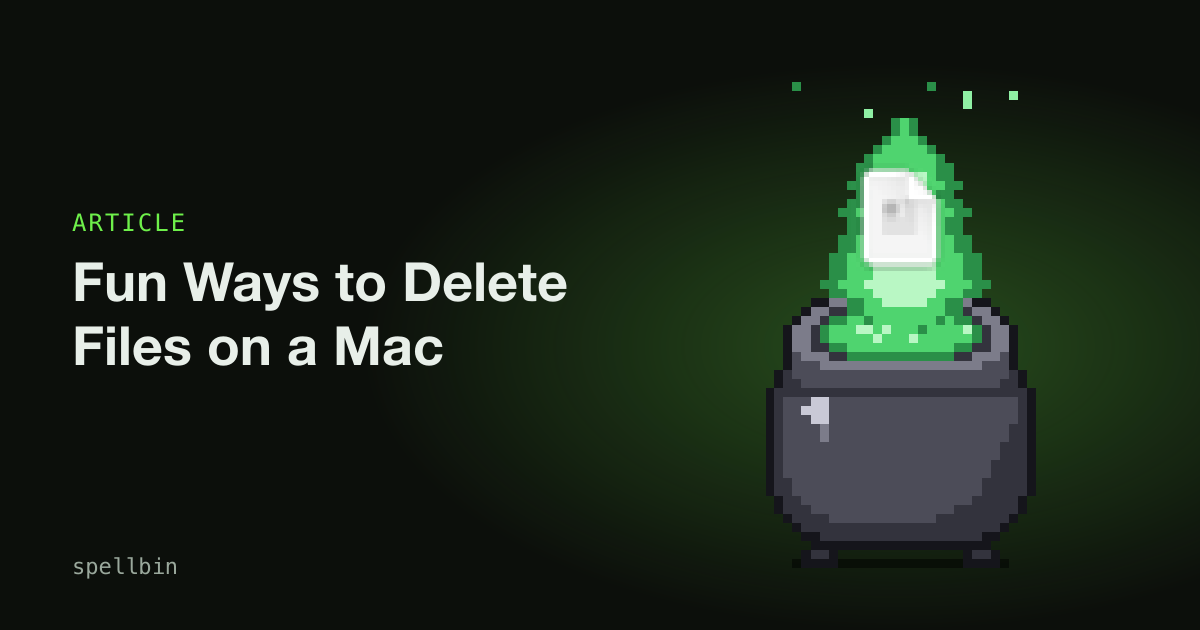
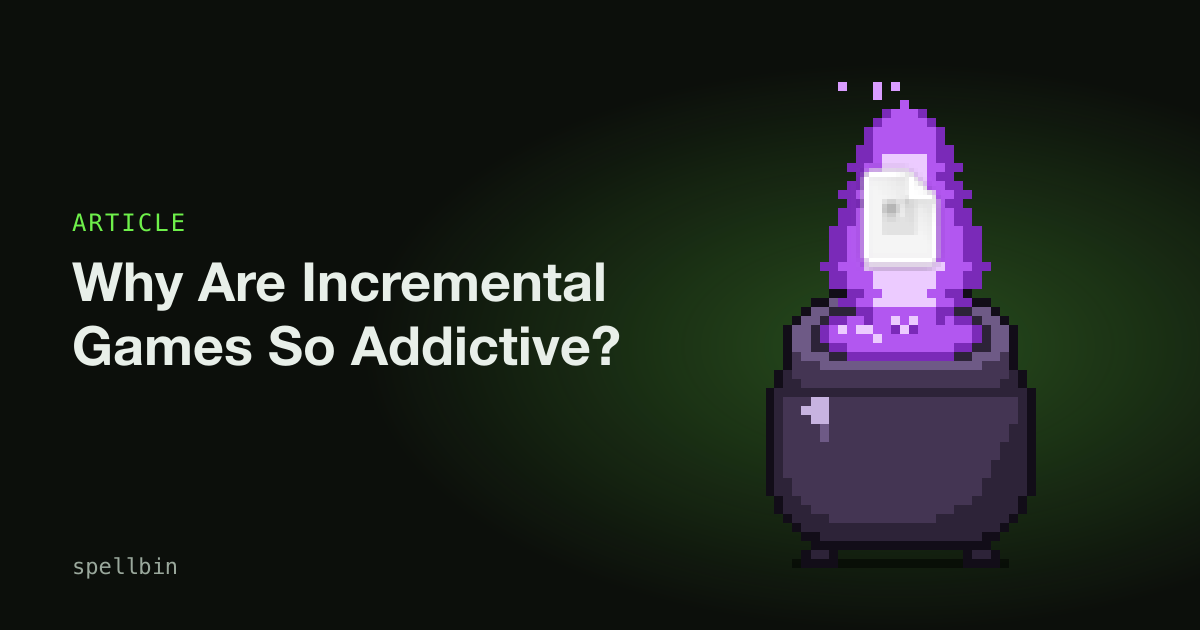
Spellbin is our own small paid Mac app: a pixel-art cauldron that sits in the Dock beside the Bin. Drop a file on it and a green flame carrying the file's thumbnail rises and dissolves, and by default the file goes to the real Bin underneath. Every drop counts towards 19 achievements that unlock 14 more cauldron skins, with stats and streaks to keep score. Think Cookie Clicker where the click is a drop. It won't clean your Mac or speed it up. It just means the clear-out you were putting off now has a number going up.
Incremental games never end. You get to decide when you are done.
Frequently Asked Questions
Are incremental games bad for you?
Incremental games are not harmful for most people. The World Health Organization says gaming disorder affects only a small proportion of people who play games. The useful test is whether play crowds out sleep, work or other things you care about. If an idle game starts to feel like an obligation, set a stopping point and close the tab.
Why are idle games so satisfying?
Idle games are satisfying because they give constant feedback for very little effort. Numbers rise while you are away, upgrades arrive in quick succession, and a short check-in turns hours of offline earnings into a burst of purchases. Research on game motivation links that sense of competence and steady progress to enjoyment and the wish to keep playing.
Do incremental games use the same psychology as gambling?
Incremental games borrow one idea from gambling: unpredictable rewards, such as golden cookies in Cookie Clicker. The difference is that idle game events add bonuses without introducing penalties, and most of the progress comes from predictable, fixed milestones. Games that sell randomised rewards for real money are a separate case.
What is prestige in an incremental game?
Prestige in an incremental game is a reset that wipes your progress in exchange for a permanent bonus, usually a multiplier on future earnings. Each run goes faster than the last. Cookie Clicker popularised the mechanic, and designer Anthony Pecorella describes it as one of the crucial mechanics behind most modern idle games.
Is the Zeigarnik effect real?
The Zeigarnik effect, the idea that people remember unfinished tasks better, has a weak record. A 2025 meta-analysis by Ghibellini and Meier found no memory advantage for unfinished tasks. It did find a reliable tendency to resume interrupted tasks, called the Ovsiankina effect, which better explains why half-finished goals in games pull people back.
Final Takeaways
- Rewards come on two schedules. Fixed milestones you can plan for, plus random bonuses that never punish you for missing them.
- The next goal is always close. The goal-gradient effect keeps you pushing as an upgrade nears.
- Unfinished goals pull you back, though the urge to resume is better supported than the memory claim.
- Prestige makes starting over feel like levelling up.
- Pick your own finish line. The game will never give you one. For more ways to add a little play to your Mac, see how to gamify your Mac.

Josh Ibbotson
Josh is an indie developer in the UK. He makes Spellbin, a pixel-art cauldron for your Dock, and Gym Note Plus.
Feed the cauldron
Spellbin is $4.99 once, for macOS 14 or later, with a 14-day money-back guarantee. Drop files on it, unlock skins, keep your Desktop tidy.
Get Spellbin for $4.99Already bought Spellbin? Download it here